Introduction: why PDFs have become a preferred target for fraudsters
The PDF format is now ubiquitous in digital exchanges. It is used to transmit sensitive documents such as payslips, bank statements, proof of address, invoices, and tax assessments. Its popularity is based on its universal compatibility, visual consistency, and ability to preserve the layout of a document regardless of the device used.
This apparent reliability has, however, contributed to creating a false sense of security. Contrary to common belief, a PDF file is not inherently secure or tamper-proof. It can be modified, reconstructed, or entirely falsified using tools accessible to the general public. This reality has led to the emergence of a specific type of fraud: PDF fraud.
Today, fake PDFs are widely used in document fraud attempts, particularly in account opening processes, rental applications, service subscriptions, or identity verification procedures. Detecting these falsifications has become a major challenge for companies and digital platforms.
What is PDF fraud?
PDF fraud consists of modifying an authentic PDF document or creating a fake PDF document in order to deceive a verification system or a recipient. The objective is generally to falsify information to obtain a financial, administrative, or contractual advantage.
This type of fraud can take several forms. In some cases, an authentic document is modified to change key information such as a name, an amount, or a date. In other cases, a document is entirely recreated to imitate an original. The result can be visually perfect, making the falsification difficult to detect with the naked eye.
It is important to understand that a PDF is simply a structured digital container. Its visual appearance does not necessarily reflect its authenticity. Two visually identical documents can have completely different internal structures, revealing a modification or falsification.
Which types of PDF documents are most frequently falsified
Certain types of PDF documents are particularly targeted by fraudsters due to their role in financial or administrative verification processes.
Payslips are among the most frequently falsified documents. Fraudsters may modify the salary amount, employer name, issue date, or contract type in order to artificially increase their financial credibility. These modifications are often used in rental applications or credit requests.
Bank statements are also a frequent target. It is possible to modify the account balance, add fictitious income, or remove negative transactions in order to present a more favorable financial situation than reality.
PDF invoices can be falsified to modify an amount or beneficiary, particularly in payment redirection fraud. This technique consists of modifying an invoice to redirect a payment to a fraudulent account.
Proof of address documents, such as utility or telecommunications bills, can also be modified to match a specific address and bypass residency verification controls.
The diversity of these documents and their widespread use make PDF fraud particularly common and difficult to detect without technical analysis.
How fraudsters modify a PDF
Fraudsters use various techniques to modify or create falsified PDFs. These techniques are often simple to implement and do not require advanced technical skills.
One of the most common methods involves using a PDF editor. Software such as Adobe Acrobat or other tools allows direct modification of PDF content, including text and graphical elements. These modifications can be performed quickly while preserving the original appearance of the document.
Another technique consists of converting a PDF into an editable format, such as a Word document. Once the content is modified, the document is converted back into PDF format. This operation alters the internal structure of the file and often leaves traces detectable during technical analysis.
In some cases, fraudsters completely recreate a PDF document by visually reproducing an original. They use similar logos, fonts, and layouts to make the falsification indistinguishable visually.
Finally, it is also possible to modify only certain parts of a PDF, for example by replacing a page or adding new elements. These partial modifications are particularly difficult to detect without in-depth analysis.
Why PDF fraud is often invisible to the naked eye
PDF fraud is often undetectable during a simple visual inspection. Modern tools make it possible to faithfully reproduce the appearance of a document, including logos, fonts, and layout. The document may appear completely authentic, even to an experienced observer.
This difficulty is explained by the difference between the visual appearance of a PDF and its internal structure. The visual rendering corresponds only to the final display of the document. It does not necessarily reflect the creation history, modifications, or technical structure of the file.
A falsified PDF can therefore appear identical to an original document while containing structural inconsistencies or traces of modification. Only technical analysis can detect these invisible anomalies.
Individuals, do you occasionally need to verify one or more identity documents ?
Professionals, do you need to integrate proof of identity validation into one of your business processes, including all European identity cards and global passports ?
How to detect PDF fraud
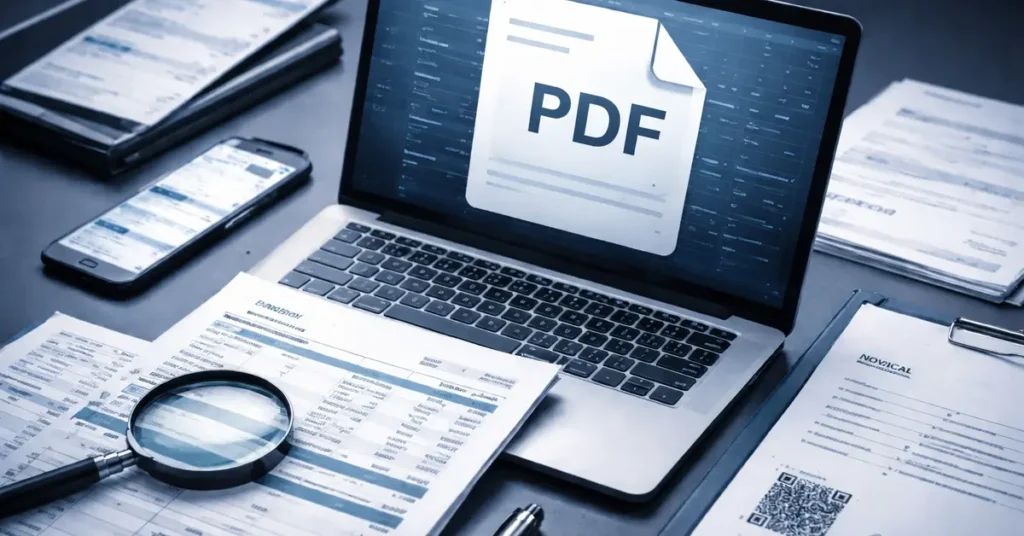
Detecting PDF fraud relies on technical analysis of the file. This analysis makes it possible to examine invisible elements of the document in order to identify potential modifications or inconsistencies.
Metadata analysis is an essential first step. Metadata contains information about the software used to create the document, creation and modification dates, and the file author. For example, a bank statement supposedly issued by a bank but created using office software may indicate falsification.
Analysis of the internal PDF structure also helps detect modifications. A PDF is composed of structured objects that define its content. When a document is modified, its structure may present inconsistencies revealing the intervention of editing software.
Forensic analysis of the PDF makes it possible to examine the document’s history, identify modifications, and detect structural anomalies. This technical approach is particularly effective for detecting falsifications invisible to the naked eye.
Finally, analysis of visual elements may reveal subtle inconsistencies, such as compression differences or variations in the fonts used.
Signs of a falsified PDF
Certain indicators may suggest that a PDF has been modified or falsified. A document whose metadata indicates software inconsistent with its supposed origin is a warning sign. Likewise, a recent modification date on a supposedly old document may indicate alteration.
The internal structure of the document may also reveal anomalies, particularly when certain parts of the file have been reconstructed or modified. An abnormal file size or technical inconsistencies may also indicate falsification.
These indicators are not always visible without technical analysis, making specialized tools particularly useful for detecting fraud.
Why visual verification is not sufficient
Visual verification of a PDF does not guarantee its authenticity. A falsified document may appear visually perfect and show no obvious anomalies.
PDF fraud relies precisely on the ability to faithfully reproduce the appearance of an authentic document. Without technical analysis, it is often impossible to distinguish an original document from a falsified one.
This is why modern document verification relies on technical and forensic analysis methods capable of examining the internal structure of files.
How to verify the authenticity of a PDF
Verifying the authenticity of a PDF requires in-depth analysis of the file. This analysis involves examining metadata, internal structure, and technical characteristics of the document.
Manual methods can identify certain inconsistencies, but they remain limited. Forensic analysis tools make it possible to automate verification and detect anomalies invisible to the naked eye.
These tools can identify modifications, structural inconsistencies, and signs of falsification, providing reliable and objective verification.
How TrustDocHub detects PDF fraud
Document verification solutions such as TrustDocHub use advanced techniques to analyze PDF files and detect falsifications. This analysis is based on examining the internal structure of the document, metadata, and technical characteristics of the file.
These systems make it possible to identify modifications, detect inconsistencies, and verify document integrity. Automated analysis provides fast and reliable results, reducing fraud risks.
This approach is particularly useful for companies, digital platforms, and organizations that need to verify the authenticity of digital documents.
Real cases of PDF fraud
Cases of PDF fraud are common across many sectors. For example, a payslip may be modified to artificially increase declared salary in order to facilitate access to housing. A bank statement may be falsified to conceal an unfavorable financial situation.
In other cases, invoices are modified to redirect payments to fraudulent accounts. These frauds can have significant financial consequences for businesses and individuals.
Detecting these frauds relies on technical analysis of documents and the use of specialized tools.
Conclusion
PDF fraud has become a common method of document fraud due to how easily files can be modified or falsified. Although these documents may appear authentic visually, their internal structure may reveal signs of modification.
Detecting these falsifications requires in-depth technical analysis of the document. Analysis of metadata, internal structure, and technical characteristics helps identify anomalies and verify file authenticity.
In a context where digital exchanges are omnipresent, PDF verification has become essential for preventing fraud and securing document verification processes.
Individuals, do you occasionally need to verify one or more identity documents ?
Professionals, do you need to integrate proof of identity validation into one of your business processes, including all European identity cards and global passports ?