Introduction
Document fraud is now one of the main risks faced by businesses, public administrations, and digital platforms. With the widespread adoption of online processes — account opening, contract signing, remote hiring, or KYC verification — digital documents have become a central element in identity verification and information validation.
However, this digital transformation has also facilitated the emergence of new forms of fraud. Thanks to publicly accessible software, PDF editors, and artificial intelligence tools, it is now possible to modify or create highly realistic documents. Some falsifications are invisible to the naked eye and require advanced techniques to be detected.
Understanding the different types of document fraud is essential to implement effective controls and secure verification processes.
What is document fraud?
Document fraud refers to the use of a falsified, modified, or fraudulently used document in order to deceive a verification system or an organization. It can involve identity documents, proof of address, payslips, bank statements, or any other document used to prove information.
There are several forms of document fraud.
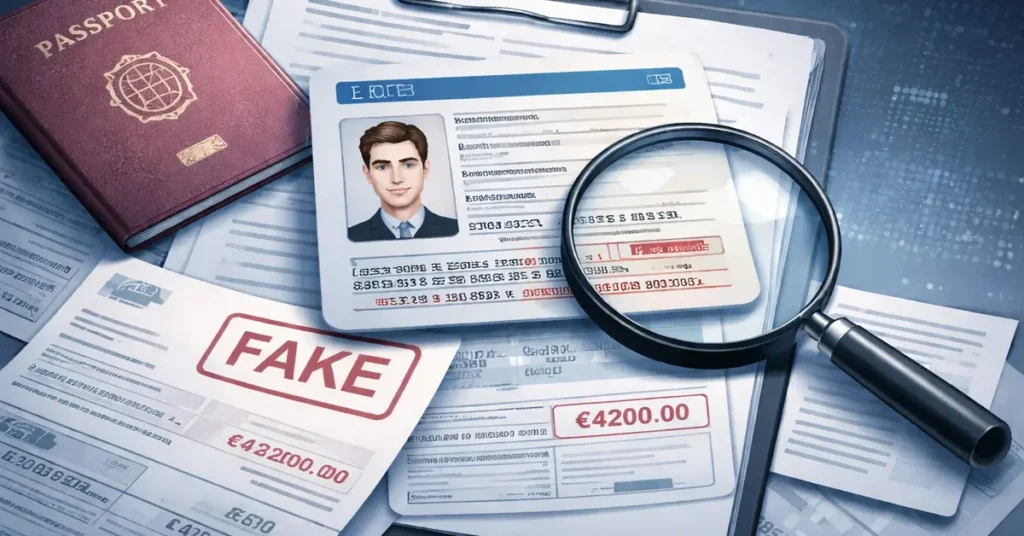
The first case is a completely fake document. This is a document entirely fabricated to imitate an official document without being authentic. This type of fraud generally requires reproducing visual elements, logos, formats, and sometimes technical structures.
The second case is a modified authentic document. In this case, the fraudster starts from a real document and modifies certain information, such as the name, date of birth, salary amount, or expiration date.
Finally, there is also the fraudulent use of an authentic document. The document is real and valid, but it is used by a person who is not its legitimate holder, as part of identity theft.
All these forms of fraud share the same objective: bypass controls and deceive verification systems.
Complete fake documents
A complete fake document, also called forgery, is a document entirely fabricated to imitate an official document. It may be a fake passport, fake identity card, fake driver’s license, or fake supporting document.
These documents are often created from templates found online or generated using graphic design software. Fraudsters reproduce the general appearance of the document, information fields, fonts, and visual elements.
However, these fake documents usually present anomalies. Security features are often missing or incorrect, proportions may be inaccurate, and inconsistencies may appear in the structure or information.
Even when the document appears visually credible, technical checks, such as MRZ verification or metadata analysis, often make it possible to detect fraud.
Modified authentic documents
Modifying an authentic document is one of the most common forms of fraud. The fraudster uses a real document and then alters certain information to serve their objectives.
Modifications may involve the name, date of birth, photo, expiration date, or other critical information. In the case of financial documents, such as payslips or bank statements, amounts may be altered to artificially improve financial standing.
These modifications are generally carried out using image editing software or PDF editors. Modern tools make it possible to achieve highly realistic results that are difficult to detect visually.
However, these modifications often leave technical traces. Pixel analysis, compression analysis, metadata inspection, or file structure analysis can reveal alterations.
MRZ fraud
The Machine Readable Zone (MRZ) is a standardized area present on passports and many identity cards. It contains structured information about the document holder and includes check digits that allow verification of data integrity.
MRZ fraud consists of modifying visible information on the document without correctly modifying the MRZ, or modifying the MRZ itself incorrectly.
This fraud is common because fraudsters often focus on the visible part of the document and neglect the control mechanisms built into the MRZ.
Check digit verification allows many falsifications to be detected automatically. An inconsistency in the MRZ is a strong indicator of fraud.
PDF document falsification
PDF documents are widely used to transmit payslips, bank statements, invoices, or contracts. Their popularity makes them a frequent target for fraud.
Fraudsters can modify amounts, dates, or personal information using PDF editors. In some cases, they reconstruct the entire document to conceal modifications.
These falsifications are often visually invisible. However, forensic analysis of the PDF structure makes it possible to detect modifications. Metadata, modification history, and the internal structure of the file may reveal anomalies.
Individuals, do you occasionally need to verify one or more identity documents ?
Professionals, do you need to integrate proof of identity validation into one of your business processes, including all European identity cards and global passports ?
Photo replacement or modification
Photo replacement is a common fraud in identity documents. The fraudster replaces the original photo with another photo in order to use the document fraudulently.
With modern tools, it is possible to integrate a new photo in a realistic way. However, these modifications often leave traces in pixels, edges, or image compression.
Forensic analysis makes it possible to detect these anomalies and identify modifications.
Identity theft using an authentic document
In some cases, the document is authentic but used by another person. This fraud involves using a valid document that does not belong to the user.
This type of fraud is more difficult to detect because the document itself is genuine. Detection relies on additional checks, such as biometric comparison or information consistency.
Techniques used by fraudsters
Fraudsters use various tools and techniques to modify or create documents.
Image editing software allows visible information to be easily modified. PDF editors allow modification of digital documents. Automated tools can also generate realistic documents.
Artificial intelligence has also facilitated the creation of fake documents. It is now possible to generate realistic images or modify documents automatically.
These tools make fraud more accessible and harder to detect without specialized tools.
How to detect document fraud
Detecting document fraud relies on multiple levels of verification.
Visual inspection can detect certain inconsistencies, such as graphical anomalies or visible errors.
Technical verification, such as MRZ analysis, allows inconsistencies in data to be detected.
Forensic analysis examines pixels, compression, and metadata to detect modifications invisible to the naked eye.
PDF structure analysis makes it possible to detect modifications and falsifications.
These combined methods make it possible to effectively detect most document fraud.
Why automated detection is essential
Manual verification has significant limitations. Some falsifications are invisible to the human eye and require technical tools to be detected.
Automated detection makes it possible to analyze documents quickly and reliably. It reduces fraud risk and improves process security.
It is now essential for organizations that handle digital documents.
Conclusion
Document fraud is a major risk in modern digital processes. It can take various forms, such as creating fake documents, modifying authentic documents, or identity theft.
Modern tools have made it easier to create fake documents, making detection more complex. However, technical verification methods such as MRZ analysis, forensic analysis, and PDF structure analysis allow fraud to be effectively detected.
Implementing automated verification systems is now essential to secure processes and prevent document fraud.
Individuals, do you occasionally need to verify one or more identity documents ?
Professionals, do you need to integrate proof of identity validation into one of your business processes, including all European identity cards and global passports ?