Article updated in February 2026 to reflect developments in French identity cards and online MRZ verification tools.
Among the mandatory documents requested in the context of a real estate rental, an identity document is required.
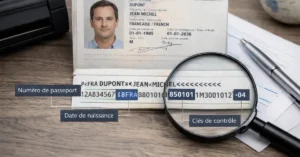
The MRZ (Machine Readable Zone) of a French identity card makes it possible to verify the consistency of the document’s information and to detect numerous anomalies (errors, inconsistencies, attempts at falsification).
Used in many contexts (KYC, real estate, banking, insurance, online platforms), the MRZ is now an essential entry point for an initial documentary verification, before any in-depth visual inspection.
How can you read, understand, and effectively verify the MRZ of a French identity card?
The answer is provided in this complete guide.
Different identity proofs
Among the identity proofs that can be provided as part of a rental application, we find:
- French or foreign identity card (with photo)
- French or foreign passport (with photo)
- French or foreign driving license (with photo)
- Temporary residence permit
- Resident card
- Card of a citizen of an EU (European Union) member state or the EEA (European Economic Area)
(source: https://www.service-public.fr/particuliers/vosdroits/F1169)
Check 0: Online MRZ verification
Before any manual inspection, it is now possible to carry out an initial automatic MRZ verification using a simple image of the document.
This step notably allows:
- automatic MRZ reading
- validation of check digits
- detection of inconsistencies between data fields
- generation of a timestamped PDF report
⚠️ However, there is no public database that allows the official validation of a French identity card.
MRZ verification makes it possible to assess the document’s consistency, but it must be complemented by a visual inspection.
Information contained in the MRZ band of the identity card
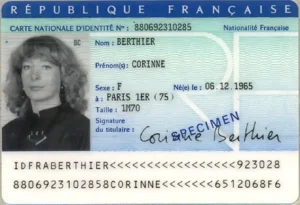
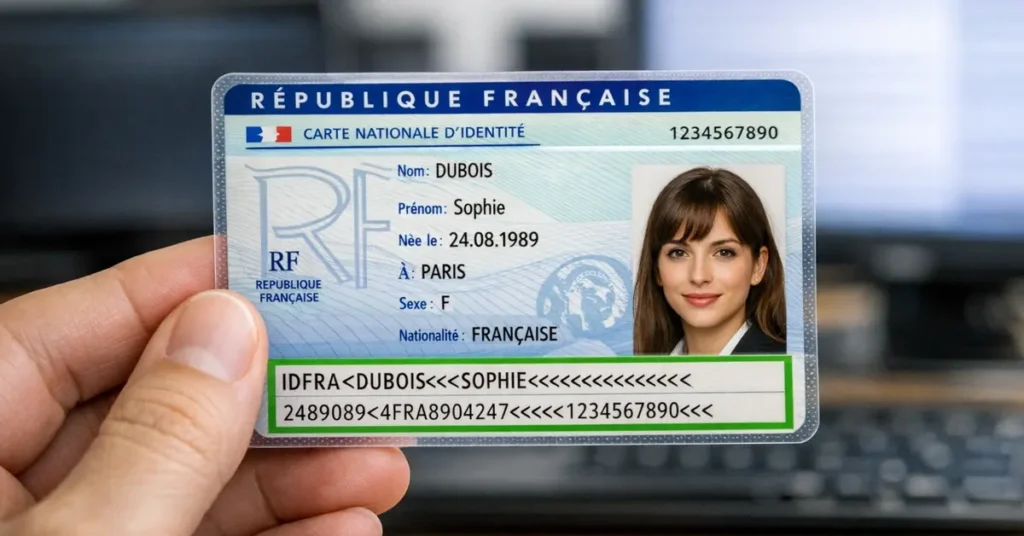
To ensure the truthfulness of the information present on an identity card and avoid risks of fraud or identity theft, it is necessary to cross-check it with the information encoded in the MRZ zone located at the bottom of the front side of the document.
(You can find concrete examples and practical cases of “modified” documents in our article on the subject).
The MRZ zone of a French identity card (1995 version) consists of two lines of text, each containing alphanumeric characters.
Here is the information typically encoded:
First line:

- Document Type: 2 characters, code indicating the document type, represented by the letters “ID”.
- Issuing Country: 3 characters, the ISO code of the issuing country, for France it is “FRA”.
- Last Name: last name of the cardholder, completed at the end by the character “<“.
- Department + internal administrative code: 6 characters:
Second line:

- Date of Issue: 4 characters, year and month of card issuance.
- Department: 2 characters, same as the department in line 1.
- Administrative code: 6 characters, assigned by the management center in chronological order based on place of issuance and application date. If the card was issued before February 2017, the first character is the same as the service digit at the end of line 1, located just after the department number (“3” located just after the department number “92” in the above example).
- Check digit: 1 character, check digit of the start of line 2.
- First name(s): cardholder’s first name, followed by the second first name separated by two chevrons (“<<“).
- Date of birth: 4 characters, year and month of the holder’s birth in YYMM format.
- Check digit: 1 character, check digit of the date of birth.
- Gender: 1 character, “M” for male, “F” for female.
- Check digit: 1 character, overall check digit.
Verify an identity card online
Security keys of the MRZ line of an ID card
A 1995 version French identity card includes 3 check digits (or security keys) that validate the information preceding them.
They help avoid transcription errors or modifications, intentional or not.
How does the algorithm work?
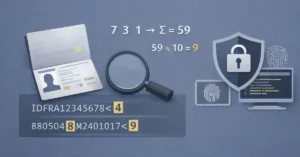
The algorithm used to create and validate the check digits is common to all identity documents: characters have a weight, which is multiplied by a factor depending on their position in the string (7, 3, and 1).
Digits have their value (“0” is worth 0, “1” is worth 1, etc., up to “9” which is worth 9), the chevron “<” also has a value of 0, while letters’ weight starts at 10 for “A”, 11 for “B”, up to 35 for “Z”.
Example
Let’s take as an example the check digit of the date of birth of the specimen above.
The character string to validate is: “651206”.
To calculate the check digit, we proceed as follows:
– “6” has a weight of 6 and is in the first position, so multiply by 7: 6 * 7 = 42
– “5” has a weight of 5 and is in the second position, so multiply by 3: 5 * 3 = 15, add to previous 42 which makes 15 + 42 = 57.
– “1” has a weight of 1 and is in the third position, so multiply by 1: 1 * 1 = 1, add to previous 57 which makes 1 + 57 = 58.
– 2 * 7 = 14 and 14 + 58 = 72
– 0 * 3 = 0 and 0 + 72 = 72
– 6 * 1 = 6 and 6 + 72 = 78
We thus obtain a total of 78, from which we take the modulo 10 (the remainder of the Euclidean division by 10), which is equivalent to keeping only the last digit, i.e. “8”.
Our check digit is therefore valid because it matches the 8 that appears on the document!
Other security elements
Other elements are available in addition to the MRZ zone to verify the authenticity of the document: you will find all the details in this article.
International ICAO Standardization of Machine Readable Zone Information
Compliance with international standards (such as those established by the International Civil Aviation Organization, ICAO) ensures that information can be read and verified uniformly worldwide, whether in data ordering or in the check digit algorithm used.
The MRZ band of a 1995 version identity card is thus built on the same pattern as that of a more recent electronic identity card, allowing interoperability with verification tools in particular.
Conclusion
The MRZ zone is therefore a crucial element of the French identity card, allowing a quick and secure verification of the holder’s identity. The integrated security technologies, notably the check digits and adherence to international standards, make counterfeiting extremely difficult, thus contributing to the overall integrity of the identification system.
To go further, it is possible to use an online document verification solution.
For example, TrustDocHub allows automatic MRZ verification of a French identity card from an image, with results available directly in the application and as a PDF report.
Individuals, do you occasionally need to verify one or more identity documents ?
Professionals, do you need to integrate proof of identity validation into one of your business processes, including all European identity cards and global passports ?