Article updated in February 2026 to reflect developments in German identity cards and online document verification tools.
The German identity card (Personalausweis) was introduced on November 1, 2010.
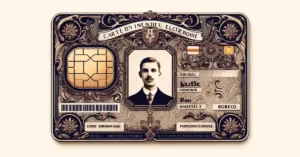
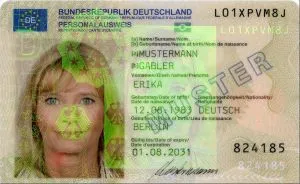
It is an electronic identity card in ID-1 format (credit-card size), incorporating a contactless chip that may contain biometric data (photograph and, optionally, fingerprints).
The purpose of this card is to enhance security, facilitate electronic identification processes, and reduce the risk of document fraud.
Used in many contexts (KYC, banking, insurance, real estate, public authorities, digital platforms), the German identity card nevertheless remains exposed to fraud attempts: expired documents, visual alterations, inconsistencies between visible fields and the MRZ, or tampering with security features.
How can you verify a German identity card online and ensure that the document presented is authentic?
This guide answers that question through 4 essential verification steps.
Need more information on how to verify the authenticity of your ID documents ? Check out our comprehensive guide to verifying ID documents, which includes all the resources available !
Check 0: automatic online verification of the German identity card
Before any visual inspection, it is now possible to perform an initial automatic verification using a simple image of the document.
This step allows in particular:
- automatic reading of the MRZ
- validation of check digits
- consistency checks between fields (name, date of birth, expiration date, nationality, document number)
- detection of common input errors or inconsistencies
- generation of a PDF report
⚠️ There is no public database allowing official validation of a German identity card.
Online verification therefore relies on document analysis and must always be complemented by a visual inspection of security features.
Check 1: general appearance of the German identity card
When access to the original document is possible, the first step is to examine the overall appearance of the card.
The card must show no signs of cutting, delamination, gluing, overprinting, or visible alteration.
Particular attention should be paid to:
- the photo area (and its edges)
- the edges of the card
- raised or embossed printed areas
Any signs of scratching, heating, partial replacement, or retouching should be considered a warning signal.
Check 2: cross-checking and consistency of information
The second step consists of verifying the consistency of the information visible on the card and its correspondence with the data encoded in the MRZ.
Key elements to cross-check:
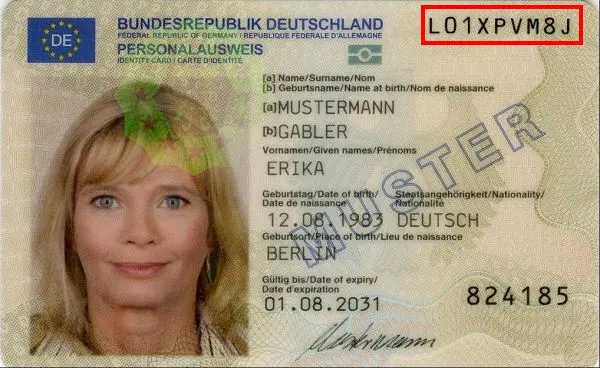
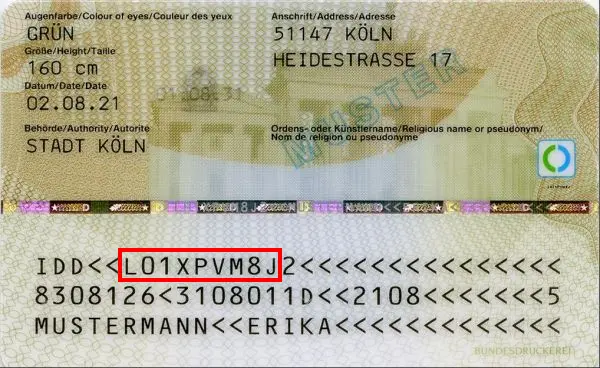
- Document number: shown on the front side and in the first MRZ line
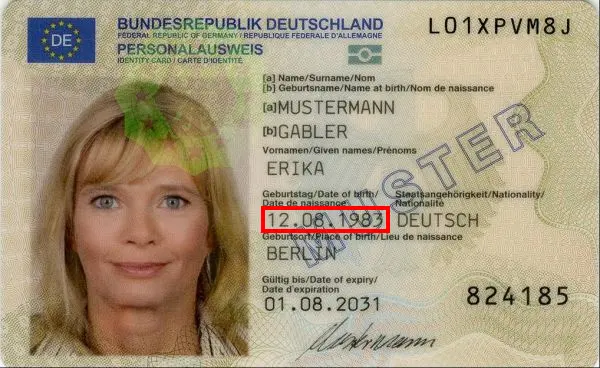
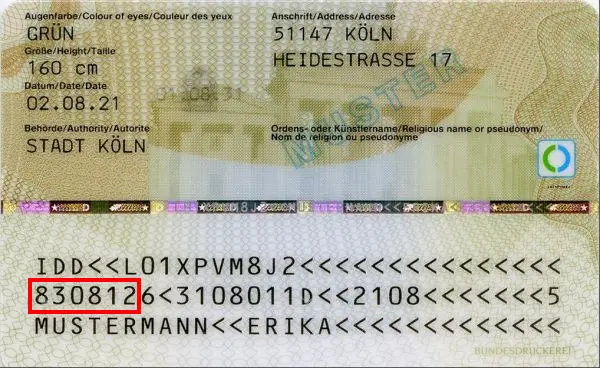
- Date of birth: shown on the card and at the beginning of the second MRZ line (YYMMDD format)
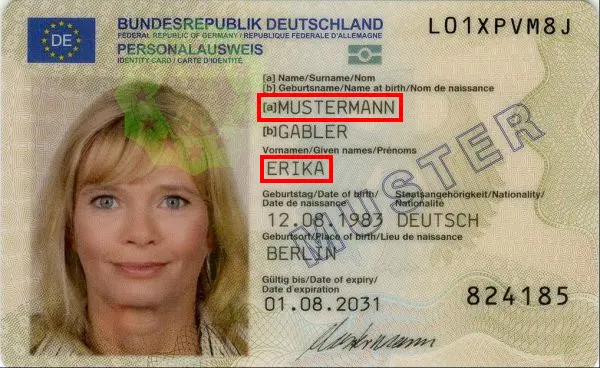
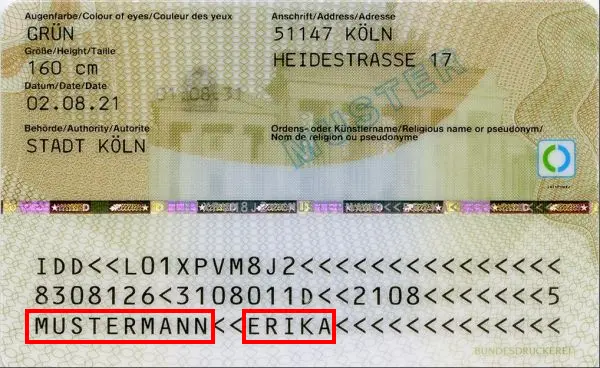
- Surname and given name(s): visible on the card and in the third MRZ line
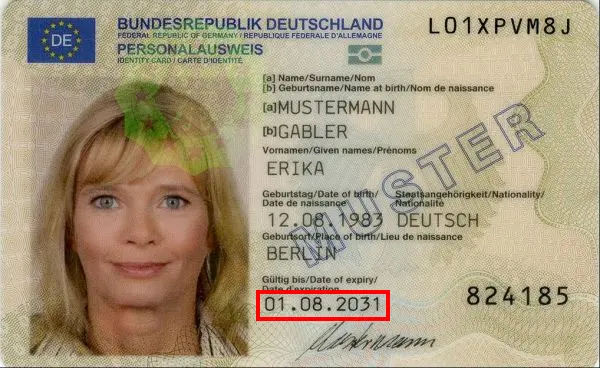
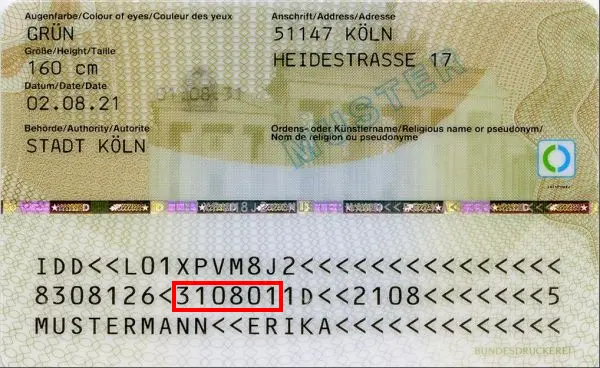
- Expiration date: shown on the card and in the second MRZ line
Any discrepancy, even minor, between visible fields and the MRZ should be treated as a warning requiring further investigation.
It is also recommended to assess the overall consistency of the document: holder’s age, validity period, and logic of date formats.
Document Number
The document number can be found in two different places: on the upper front part and in the first line of the MRZ (Machine Readable Zone).
Both must be identical:
Date of Birth
The date of birth of the holder can also be found in two different places: in the middle of the front side of the card, and at the beginning of the second MRZ line in the format YYMMDD:
Surname and First Name(s)
Similarly for surnames and first names, which can be found on the front side of the card and in the third line of the MRZ:
Card Expiry Date
Finally, the last element that appears twice on the card: the expiry date, which can be found on the front and also in the second MRZ line in the format YYMMDD:
Individuals, do you occasionally need to verify one or more identity documents ?
Professionals, do you need to integrate proof of identity validation into one of your business processes, including all European identity cards and global passports ?
Check 3: verification of the MRZ and security check digits
The German identity card includes a three-line MRZ compliant with ICAO standards.
The MRZ reproduces the main document data in a standardized format and includes four check digits designed to detect reading errors and many types of forgery.
MRZ analysis makes it possible to:
- verify the document structure
- mathematically validate encoded data
- detect transcription errors or inconsistencies
The check digits rely on the standard ICAO algorithm using fixed weights (7, 3, 1), making this verification reliable, fast, and easy to automate.
Composition of the MRZ on the German identity card
First line

- Document Type: 2 characters, code indicating the document type, represented by the letters “ID”.
- Issuing Country: 3 characters, the ISO 3166-1 alpha-3 code of the issuing country.
- Card Number: 9 characters, unique card number.
- Check Digit: 1 character, check digit of the unique card number.
- End of line: 15 characters, chevrons “<” used to fill the line.
Second line

- Date of Birth: 6 characters, year, month, and day of birth in the format YYMMDD.
- Check Digit: 1 character, check digit of the date of birth.
- Separator: 1 chevron “<”
- Expiry Date: 6 digits, card expiry date in the format YYMMDD.
- Check Digit: 1 character, check digit of the expiry date.
- Country Code: 3 characters, ISO 3166-1 alpha-3 code of the holder’s nationality.
- Separator: 2 chevrons “<”
- Date of Issue: 4 characters, card issue date in the format YYMM (e.g., August 2021).
- Check Digit: 1 character, check digit of the concatenation of characters from line 1 (positions 6-15), line 2 (positions 1-7), and line 2 (positions 9-15).
Third line

- Holder’s surname and first names: holder’s surname and first names, starting with the surname followed by the first name. The surname and first name are separated by two “<” characters. In the case of a compound surname, compound first name, or multiple first names, they are separated by a single “<” character. Spaces and apostrophes are replaced by “<”, and the name is truncated to 30 characters if needed, with any accents removed. The line is then completed with the “<” character.
Security keys of the MRZ line on the German identity card
A German identity card contains 4 check digits (or security keys) that validate the information preceding them.
They help prevent transcription errors or modifications, whether intentional or not.
How does the algorithm work?
The algorithm used to create and validate the check digits is common to all identity documents: characters have weights multiplied by factors depending on their position in the string (7, 3, and 1).
Digits have their face value (“0” equals 0, “1” equals 1, …, “9” equals 9), the chevron “<” has a value of 0, and the weight of letters starts at 10 for “A”, 11 for “B”, up to 35 for “Z”.
Example
Let’s take as an example the check digit for the date of birth from the specimen above.
The string to validate is: “830812”.
To calculate the check digit, we proceed as follows:
– “8” has a weight of 8 and is in the first position, so multiply by 7: 8 * 7 = 56
– “3” has a weight of 3 and is in the second position, so multiply by 3: 3 * 3 = 9, add to previous 56: 9 + 56 = 65.
– “0” has a weight of 0 and is in the third position, so multiply by 1: 0 * 1 = 0, add to previous 65: 0 + 65 = 65.
– 8 * 7 = 56 and 56 + 65 = 121
– 1 * 3 = 3 and 3 + 121 = 124
– 2 * 1 = 2 and 2 + 124 = 126
We obtain a total of 126, from which we take modulo 10 (the remainder of division by 10), which is the last digit, i.e. “6”.
Our check digit is therefore valid because the document shows a “6”!
Check 4: verification of physical security features
This final step aims to confirm the physical authenticity of the German identity card.
It complements document analysis with the inspection of security features that are difficult to reproduce, including:
- holographic devices visible depending on viewing angle
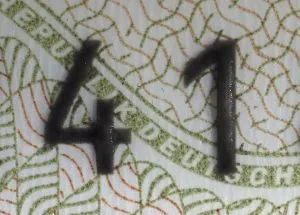
- raised laser engraving
- secondary “ghost” image
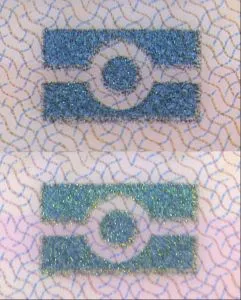
- optically variable inks
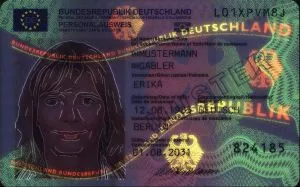
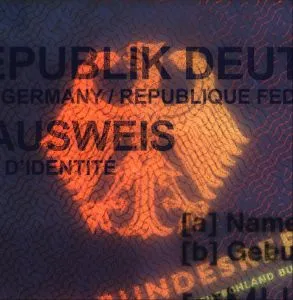
- elements visible only under ultraviolet (UV) light
Some of these features can be checked with the naked eye, while others require specialized equipment.
Front side
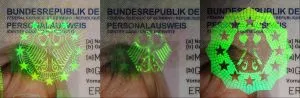
Holographic device
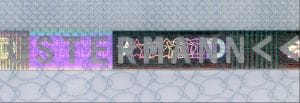
Various next-generation holographic devices are used to protect, among other things, the cardholder’s photograph.
These change color depending on the orientation:


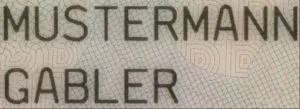
Laser engraving
Laser engraving of characters which are raised.
This device is found on the front, at the top left of the card:
Ghost photo
A secondary “ghost” photo is visible to the right of the main photo:

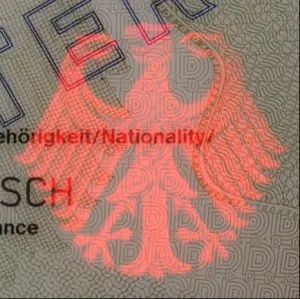
Optically variable ink
The color changes depending on the orientation of the card.
This device is found on the front, at the top middle of the card:
Ultraviolet check
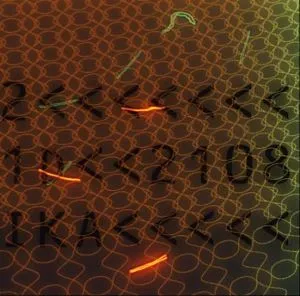
Some elements are visible only under ultraviolet rays, but this requires specialized equipment (thus not suitable for verifying a German identity card online):
Back side
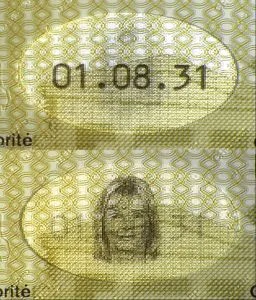
Optically variable mark
Some elements are visible by changing the orientation of the card:

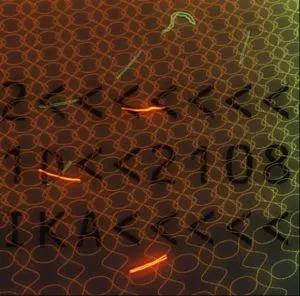
Ultraviolet check
Some elements are visible only under ultraviolet rays, but this requires specialized equipment:

Conclusion
You now have a structured method for verifying a German identity card online: MRZ analysis, cross-checking of information, followed by visual inspection of security features.
Even without specialized equipment, this combined approach already allows detection of a large proportion of common document fraud cases.
To go further, it is also possible to use an online document verification solution.
For example, TrustDocHub enables automatic verification of a German identity card from an image, with results returned directly in the application and as a PDF report.
Individuals, do you occasionally need to verify one or more identity documents ?
Professionals, do you need to integrate proof of identity validation into one of your business processes, including all European identity cards and global passports ?